Homework 4
Due: Sunday, Aug 3rd, 2025, 11:59pm PDT on Gradescope
Instructions
The entirety of this homework can be done in pairs if you want to.
There are be 2 types of problems:
-
Written problems are marked with ✍️.
- Must be done individually.
- Please submit a PDF of your solutions to Gradescope.
- For each sub-problem, please provide a self-grade out of 2 points: 2 for a fully solved problem with a correct solution, 1 for a partially correct attempt with all work shown, and 0 for no attempt. If you're unsure whether your solution is correct, you can leave it as
?, and I will grade it for you. - On the first page of your solutions, please include your name (and your partner's), and a table containing the self-grades for each sub-problem, like this:
Problem Sub-problem Self-grade (0/1/2/?) 1 A 2 1 B 2 1 C 1 1 D ? - If you handwrite your solutions, please write clearly and legibly.
-
Coding problems are marked with 🧑💻.
- Coding problems are autograded on Gradescope.
- You can submit as many times as you want.
- No late days are allowed for coding problems since I need to submit your grades to GOLD.
Other important notes:
-
Problems (written or coding) marked with ⭐️ are extra credit problems. You can do them for fun and for extra credit, but they are completely optional.
-
You're encouraged to talk about the problems with the instructor, the TA, and your classmates, but you must write your own solutions.
-
Note you won't be able to turn in corrections to homework problems, unlike quizzes.
-
Use of generative AI tools and coding assistants is not allowed for this assignment.
-
If you have any questions about the assignment, please post them in the
#hw4Discord channel, or come to the office hours.
Part 1 - Programming in Lamp
Download the starter code from here.
Carefully read the updated Lamp Reference Manual. Again, a reference implementation of Lamp is available on CSIL as ~junrui/lamp (for evaluation) and ~junrui/lamp-ty (for typing). Please use them to test your Lamp programs.
Before you jump into coding, let us explain some new shiny concrete syntax added to Lamp:
-
(Recursive) type equations are written as
type <TypeName> = <Type>where
<TypeName>is the name of the type (a global variable, so needs to be capitalized), and<Type>is the type that the name is defined to be equal to. For example, the natural number type is defined as:type Nat = +{ 'zero: (), 'succ: Nat } -
Just like abbreviations, type equations can be mutually recursive, since type names have global scope.
-
The elimination form for product types is provided as a syntactic sugar:
let (x1, ..., xn) = e1 in e2which is desugared by the parser into:
match e1 { (x1, ..., xn): e2 } -
The elimination form for sum types is provided as a syntactic sugar:
switch e1 {
    'l1 x1: e1,
    'l2 x2: e2,
    ...
}
which is desugared by the parser into:
match e1 { 'l1 x1: e1, 'l2 x2: e2, ... } -
1-tuples are automatically unpacked, so
(1)is parsed into a number, instead of a 1-tuple that contains the number.(Nat)is parsed into the typeNat, instead of a 1-tuple that contains the typeNat.(x)is parsed into the pattern variablex, instead of a 1-tuple pattern that contains the variablex.
-
In injection expressions and injection patterns where the contained expression/pattern is the unit
(), you can use'<label>instead of'<label> (). For example, if we define the custom Boolean type as:type MyBool = +{ 'true: (), 'false: () }then we can write the injection expression as:
'trueand define the negation function as:
def Not: MyBool -> MyBool = \b.
    switch b {
        'true: 'false,
        'false: 'true
    }
instead of the more verbose:
def Not: MyBool -> MyBool = \b. switch b { 'true (): 'false (), 'false (): 'true () } -
It is quite common to define a function that takes an argument and immediately pattern matches on it. In this case, you can use the following syntactic sugar:
def MyNot: MyBool -> MyBool = \{
    'true: 'false,
    'false: 'true
}
which is desugared by the parser into:
def MyNot: MyBool -> MyBool = \_arg.
    switch _arg {
        'true: 'false,
        'false: 'true
    }
}
For all problems in Part 1 (this part) of the HW, please use the reference implementation to check if the Lamp programs you wrote are correct or not!!! You'll need to use them as test cases for Part 2 (implementing the Lamp language).
Problem 1 (✍️ written, 2 pts)
- Define
MaybeNatas a sum type with the following constructors:'nonefor representing failure,'somefor representing a successful result that contains natural number.
- Using the unsafe division you wrote in HW2, implement a function
SafeDivthat takes two natural numbers and returns aMaybeNat. If the second number is zero, it should return'none, otherwise it should return'somewith the result of the division. - Using
SafeDiv, implement a functionSafeModthat takes two natural numbers and returns aMaybeNat. If the second number is zero, it should return'none, otherwise it should return'somewith the result of the modulo operation. - Define
MyBoola recursive sum type with the following constructors:'truefor true,'falsefor false.
- Define a function
MyBool2Boolthat takes aMyBooland returns aBool. The function should returnTruefor'trueandFalsefor'false. - Define funtions
MyAndandMyOrthat take twoMyBools and return aMyBool. You should use pattern matching. For each function, the match should have no more than two branches. Hint: combine tuple patterns with sum type patterns. - Define a type
MyNatas a recursive sum type with the following constructors:'zerofor zero,'succfor the successor of a natural number.
- Define a function
MyAddthat takes twoMyNats and returns aMyNat. You should use pattern matching. The match should have no more than two branches.
Problem 2 (✍️ written, 2 pts)
Pick either this problem, or Problem 3. You do not need to do both, although you are more than welcome to.
- Define the
Listtype as a recursive sum type with the following constructors:
'nilfor the empty list,'consfor a non-empty list that contains a head element (Nat) and a tail (List).
- Define a function
def Incr: Nat -> List -> Listthat takes aNatand aList, and returns a newListwhere each element of the original list is incremented by the givenNat. - Define a function
def Len1: List -> Natthat takes aListand returns the length of the list as aNat. This function should be recursively, and should not call any other helper function. This function will visit each element exactly twice: once before the recursive call and once after the recursive call. - Define a function
def Len2: List -> Natthat takes aListand returns the length of the list. The function should visit each element exactly once. Hint: defineLenAcc: Nat -> List -> Natthat takes an accumulatorNatand aList, where the accumulator is the length of the list so far. Then callLenAccwith an initial value of zero inLen2. - Define a function
def Sum1: List -> Natthat takes aListofNats and returns the sum of the elements as aNat. This function should be recursively, and should not call any other helper function. - Define a function
def Sum2: List -> Natthat takes aListofNats and returns the sum of the elements as aNat. The function should visit each element exactly once. Hint: defineSumAcc: Nat -> List -> Natthat takes an accumulatorNatand aList, where the accumulator is the sum of the elements so far. Then callSumAccwith an initial value of zero inSum2. - Define a function
def Max1: List -> MaybeNatthat takes aListofNats and returns the maximum element as aMaybeNat. If the list is empty, it should return'none, otherwise it should return'somewith the maximum element. This function should be recursively, and should not call any other helper function. - Define a function
def Max2: List -> MaybeNatthat takes aListofNats and returns the maximum element as aMaybeNat. The function should visit each element exactly once. Hint: defineMaxAcc: Nat -> List -> Natthat takes an accumulatorNatand aList, where the accumulator is the maximum element found so far. Then, inMax2, pattern match on the input list. If it is empty, return'none, otherwise callMaxAccwith the first element as the initial value of the accumulator. - Define a function
def Rev1: List -> Listthat takes aListand returns a newListthat is the reverse of the original list. Hint: define a helper functionRevAcc: List -> List -> Listthat takes an accumulatorListand aList, where the accumulator is the reversed list so far. Then callRevAccwith an initial value of'nilinRev1. - Define a function
def Append: List -> List -> Listthat takes twoLists and returns a newListthat is the concatenation of the two lists. You should use recursion + post-order traversal. - Define a function
def Rev2: List -> Listthat takes aListand returns a newListthat is the reverse of the original list. This function should be recursively, and should not call any other helper function except forAppend.
Problem 3 (✍️ written, 2 pts)
Pick either this problem, or Problem 2. You do not need to do both, although you are more than welcome to.
-
Define a type
Treeas a recursive sum type with the following constructors:'leaffor a leaf node that contains a natural number,'nodefor an internal node that contains a natural number and two subtrees.
-
Define a function
def Search: Nat -> Tree -> MaybeNatthat takes a natural number and aTree, and returns aMaybeNat. If the number is found in the tree, it should return'somewith the number, otherwise it should return'none. You should not assume that the tree is a binary search tree. -
A red-black tree is a binary search tree where each node can be either red or black (if you never learned red-black trees in your data structures course, you can watch a quick YouTube video like this one). In Lamp, we can represent a red-black tree as a recursive sum type with the following constructors:
rec RBTree = +{
    'leaf: (),
    'r: (Nat, RBTree, RBTree),
    'b: (Nat, RBTree, RBTree)
}
Additionally, a red-black tree should satisfy the following invariants:
- There are no two red nodes in a row.
- Every path from the root to a leaf has the same number of black nodes.
To insert a number into a red-black tree, simply treat the tree as a binary search tree (so use each node to decide which subtree to go to):
def Insert: Nat -> RBTree -> RBTree = \x. \t.
  match t {
   'leaf: 'r (x, 'leaf, 'leaf),
   'r (y, l, r):
       if x == y then t
       else if Lt x y then Balance ('r (y, Insert x l, r))
       else Balance ('r (y, l, Insert x r)),
   'b (y, l, r):
       if x == y then t
       else if Lt x y then Balance ('r (y, Insert x l, r))
       else Balance ('r (y, l, Insert x r))
}
(You need to copy over your
Ltfunction from HW2.)After the inserting the number, the first invariant may be violated (the second invariant will still hold). So we need to call a
Balancefunction to fix the tree. TheBalancefunction should take a red-black tree that may violate the first invariant, and return a new red-black tree that satisfies both invariants. The balance function is illustrated in the following diagram. There are 4 cases to consider: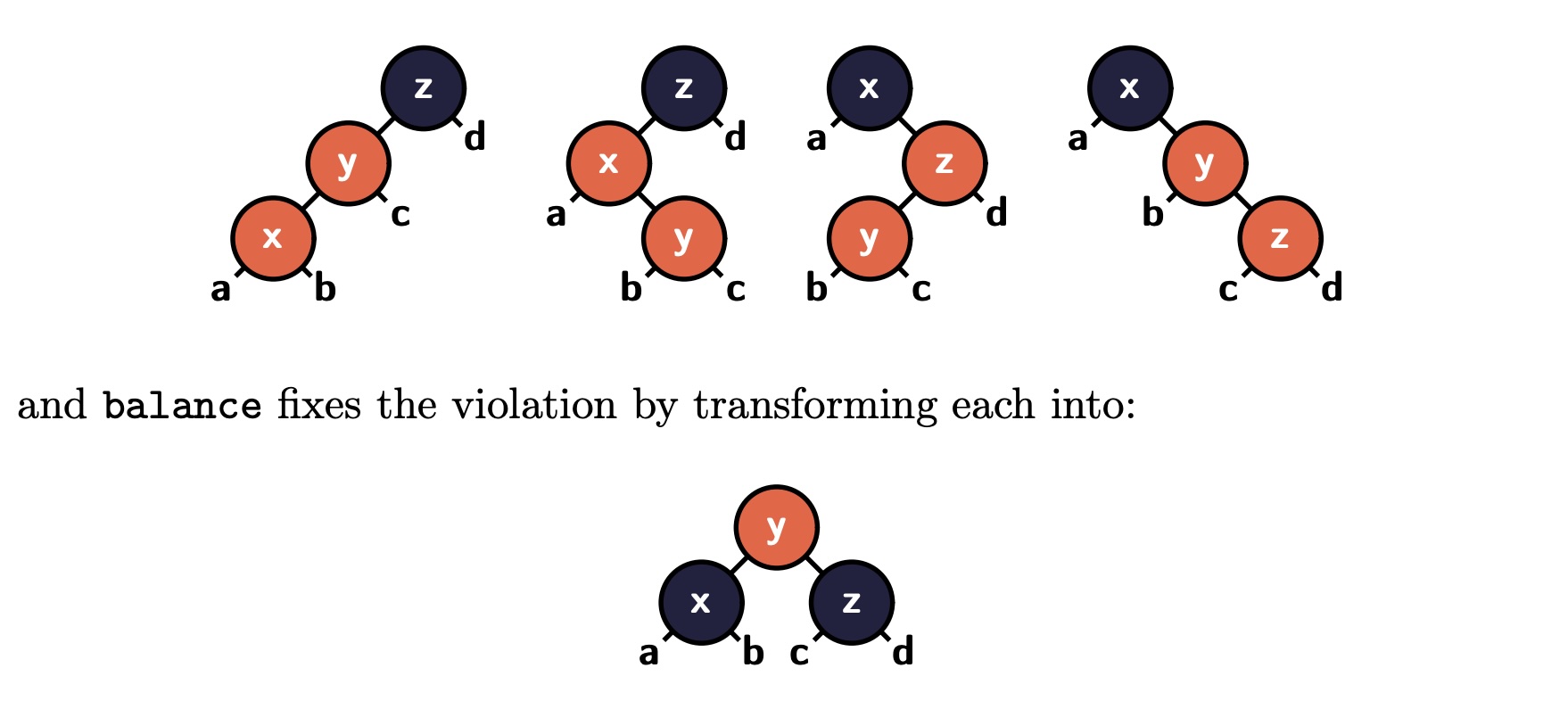
Your task is to implement the
Balancefunction:def Balance: RBTree -> RBTree = \{ <pattern 1>: <result tree>, <pattern 2>: <result tree>, <pattern 3>: <result tree>, <pattern 4>: <result tree>, t: t }Each pattern should describe one of the 4 cases where the tree violates the first invariant (as illustrated in the topf half of the diagram above), and the result tree in all branches should be the red-black tree that no longer violates the first invariant (as illustrated in the bottom half of the diagram above). The last branch
t: tsimply matches any tree that does not violate the first invariant, and returns it unchanged.
Part 2 - Implementing the Lamp Language
Download the starter code from here.
Problem 1 (🧑💻 coding, 10 pts)
The operational semantics of Lamp is already implemented in the eval function. You're highly encouraged to read the code and understand how it works. Your task is to implement the subst function.
Hint
The only tricky case is when you substitute in a pattern-match branch. Remember the slogen:
Substitution replaces free variables. The
sigmadictionary contains keys which are (free) variables to be replaced. The pattern of a branch may contain variables, which bind all references in the expression of that branch.
Finally, to run your interpreter, you can do python -m backend.eval < [path to a Lamp file].
Problem 2 (🧑💻 coding, 50 pts)
Implement the bidirectional type system for Lamp. The system is specified using inference rules in the Lamp Reference Manual. Your task is to finish the implementation of
- the
synthfunction, which implements the type synthesis judgment - the
checkfunction, which implements the type checking judgment.
Note that we've slightly adjusted the bidirectional type system for operations related to base types (i.e., Nat and Bool), so you may need to update your implementation from HW3.
You will also need to design and implement type checking for pattern matching.
- As a baseline, you should implement the
helperfunction in thematch_function, which checks whether a type matches a pattern, and returns a mapping from (pattern) variables to types. You should derive the implementation of this function by "looking at" the operational semantics of pattern matching "through a pair of foggy glasses". The operational semantics of pattern matching is defined formally in the language reference manual using the judgmentv ⋈ p -> σ, and implemented in thematch_function in eval.py. Ideally, you should design an analogous judgmentt ⋈ p -> Σfor checking whether a type matches a pattern using a set of inference rules, and then implement your rules in Python. - You should also check that patterns in all branches collectively exhaust the type of the matched expression. In other words, your type checker should ensure that it can never happen that a pattern match fails because none of the branches match the value. This is a very challenging problem, and you should try your best to solve it, and the autograder will award points for partially correct solutions. As a hint, think of both types and patterns as describing certain sets of values. The exhaustiveness check amounts to checking that the union of the sets described by the patterns is a superset of the set described by the type of the matched expression.
To run your type checker, you can do python -m backend.typing < [path to a Lamp file].